Who Wants to Be a Millionaire: Education and Upbringing
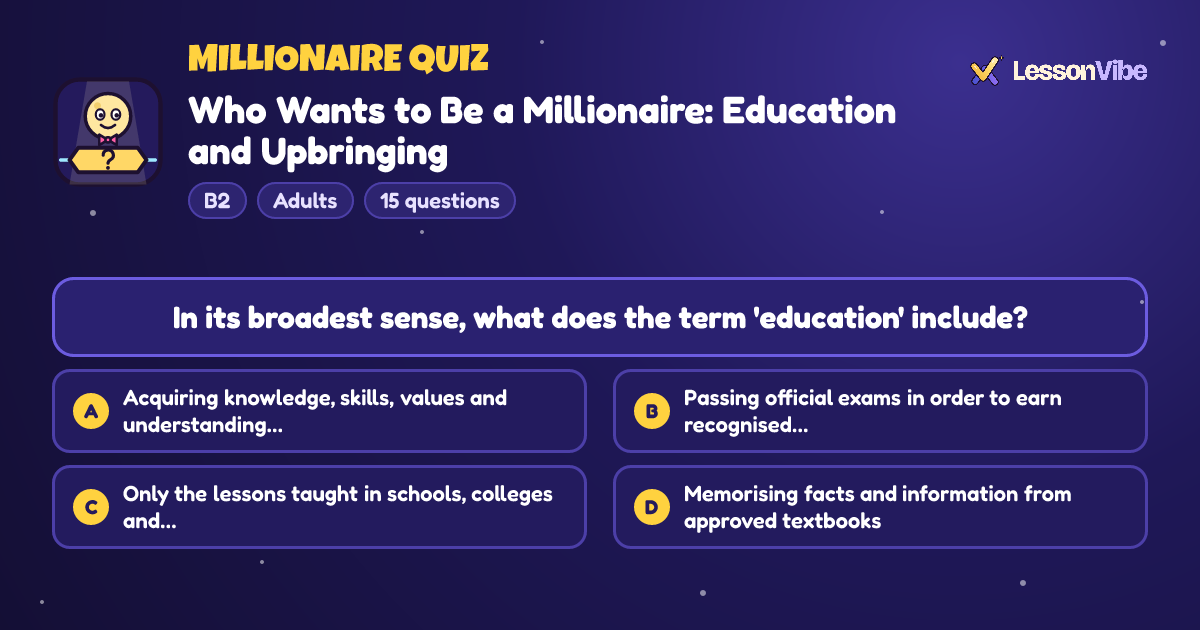
A 15-question team quiz for adults on key ideas in education: upbringing, learner autonomy, moral and civic development, teaching methods, assessment and school culture. Questions move from core definitions to applied classroom scenarios.
A free Millionaire Quiz for Adults at CEFR B2 level. Topic: Education: The overall process of acquiring knowledge, skills, values, and understanding through school and life.
Questions
- In its broadest sense, what does the term 'education' include? — A) Acquiring knowledge, skills, values and understanding through school and life experiences B) Only the lessons taught in schools, colleges and universities C) Passing official exams in order to earn recognised qualifications D)…
- Which term describes the deliberate guidance given to learners to build positive habits, moral character and responsible behaviour? — A) Training B) Upbringing C) Socialisation D) Instruction
- A student sets her own study goals, chooses her own resources and makes responsible choices without the teacher checking on her. What does this show? — A) Direct instruction B) Guided practice C) Learner autonomy D) Peer tutoring
- Which classroom activity is the best example of intellectual upbringing? — A) Students volunteer together at a local food bank B) Students practise polite manners during the school lunch break C) Students compare two news articles and judge which one uses more reliable evidence D) Students discuss…
- Moral upbringing mainly aims to develop which of the following in students? — A) Logic, curiosity and critical thinking B) Knowledge of rights, community duties and cooperation C) Punctuality, neatness and obedience to rules D) Fairness, honesty, empathy and personal integrity
- A class learns about voting rights, organises a neighbourhood clean-up and practises resolving conflicts in groups. Which area of upbringing does this mainly represent? — A) Civic and social upbringing B) Physical upbringing C) Intellectual upbringing D) Moral upbringing
- A teacher always arrives on time, admits her own mistakes and listens respectfully. According to the idea of pedagogical modeling, how do students mainly learn these values? — A) By memorising the official school rules B) By observing how the teacher consistently acts C) By reading about good…
- Instead of giving the answer, a teacher asks, 'Why do you think that?' and 'What evidence supports your idea?' Which method is the teacher using? — A) Rote learning B) Reasoned dialogue C) Lecture-based instruction D) Direct correction
- According to the lesson's definition, which person best fits the description of an 'educated person'? — A) Someone who has memorised a very large amount of information B) Someone who applies knowledge ethically, evaluates evidence critically and keeps learning C) Someone who holds several advanced…
- Which teaching approach focuses on students' needs and uses course materials that reflect students' real experiences? — A) Exam-centred learning B) Curriculum-centred learning C) Teacher-centred learning D) Student-centred learning
- In a business course, learners plan and run a small market stall, then reflect on what worked and what did not. Which educational philosophy does this reflect? — A) Reasoned dialogue B) Pedagogical modeling C) Programmed instruction D) Experiential education
- What is the main purpose of non-punitive assessment? — A) To rank students against each other as fairly as possible B) To identify which students have not completed the reading C) To remove all grades, tests and quizzes from the course D) To highlight what students have learned rather than punish…
- A teacher regularly shows genuine warmth and offers strong emotional support to students. What is this approach most likely to build? — A) Strict classroom discipline B) Greater dependence on external rewards C) A trusting teacher-student relationship D) Stronger competition between students
- Which practice best reflects culturally relevant teaching? — A) Translating every course material into students' first languages B) Regularly connecting lessons to students' cultural backgrounds and experiences C) Grouping students by cultural background for separate lessons D) Running a single…
- Students learn to stay quiet, wait their turn and respect authority, not from official lessons but from everyday school routines. What is this called? — A) Hidden curriculum B) Core curriculum C) Spiral curriculum D) Formal curriculum
Printable worksheet
This Millionaire Quiz comes with a free printable worksheet: 2 parts for students to do after the game, and an answer key for the teacher. It prints at three levels (Support, Core and Challenge); this is the Challenge sheet. Sign in free to print the whole sheet.
What's on the worksheet
- Answer from memory · No options this time. Write the answer.
- Write your own question · Write a new question about education: the overall process of acquiring knowledge, skills, values, and understanding through school and life, with one right answer and three wrong ones.
Part 1: Answer from memory
No options this time. Write the answer.
- In its broadest sense, what does the term 'education' include?
- Which term describes the deliberate guidance given to learners to build positive habits, moral character and responsible behaviour?
- A student sets her own study goals, chooses her own resources and makes responsible choices without the teacher checking on her. What does this show?