SWOT Analysis in Arts Leadership
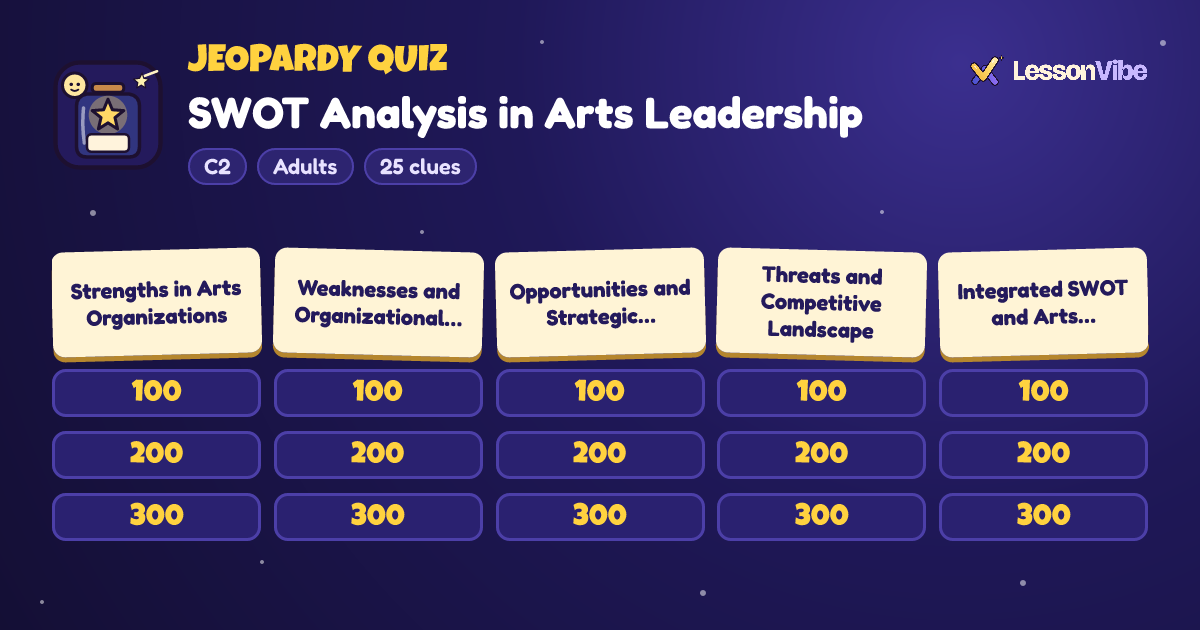
An advanced ESL Jeopardy game exploring SWOT analysis through the lens of arts management and leadership. Designed for C2-level adult learners to discuss strategic planning, organizational challenges, and competitive positioning in cultural institutions.
A free Jeopardy Quiz for Adults at CEFR C2 level. Topic: SWOT analysis.
Categories
- Strengths in Arts Organizations
- Weaknesses and Organizational Control
- Opportunities and Strategic Planning
- Threats and Competitive Landscape
- Integrated SWOT and Arts Leadership
Questions
- Strengths in Arts Organizations (100): What is one internal advantage that a well-established theatre company might leverage when competing with newer digital entertainment platforms?
- Strengths in Arts Organizations (200): Explain how an arts organization's diverse staff expertise in planning and organizing events could serve as a competitive strength in the cultural marketplace.
- Strengths in Arts Organizations (300): In what ways might a museum's collection and curatorial knowledge function as both a strength and a foundation for strategic planning in the digital age?
- Strengths in Arts Organizations (400): How could an arts organization's ability to attract talented staff through its directional leadership philosophy become a sustainable competitive advantage, and what organizational function does this
- Strengths in Arts Organizations (500): Compare your own cultural institution's primary strengths with those of a hypothetical competitor. How might you articulate these differences to secure funding or partnerships, and what role does stra
- Weaknesses and Organizational Control (100): What is a common operational weakness that many mid-sized arts organizations face regarding resource allocation?
- Weaknesses and Organizational Control (200): Describe how inadequate controlling mechanisms in an arts organization might lead to inefficient staffing decisions and poor program outcomes.
- Weaknesses and Organizational Control (300): What structural weaknesses might prevent an arts organization from effectively implementing its planning and organizing functions across multiple departments?
- Weaknesses and Organizational Control (400): Analyze how weak directional leadership combined with inadequate controlling systems could undermine an arts organization's ability to execute its strategic vision, and propose a corrective measure.
- Weaknesses and Organizational Control (500): Identify a specific weakness in your sector or organization type, explain how inadequate controlling mechanisms might exacerbate it, and discuss what planning adjustments could mitigate this vulnerabi
- Opportunities and Strategic Planning (100): Name one external opportunity that digital technology has created for arts organizations in recent years.
- Opportunities and Strategic Planning (200): Explain how demographic shifts and changing audience preferences present both an opportunity and a planning challenge for traditional arts institutions.
- Opportunities and Strategic Planning (300): How might increased government or philanthropic funding for cultural equity initiatives represent a strategic opportunity, and what organizational functions must align to capitalize on it?
- Opportunities and Strategic Planning (400): Evaluate how a partnership opportunity with a technology company could fundamentally reshape an arts organization's strategic planning, and what risks might emerge from inadequate controlling measures
- Opportunities and Strategic Planning (500): Identify an emerging opportunity in the arts sector relevant to your region or interest, articulate how your organization could strategically plan to seize it, and explain what staffing and directiona
- Threats and Competitive Landscape (100): What is one significant external threat that traditional performing arts organizations face in the contemporary entertainment environment?
- Threats and Competitive Landscape (200): Describe how economic downturns or reduced public funding threaten the operational viability of arts organizations and impact their staffing capabilities.
- Threats and Competitive Landscape (300): How might demographic and cultural shifts pose a threat to an arts organization's traditional audience base, and what planning adjustments might address this vulnerability?
- Threats and Competitive Landscape (400): Analyze how the threat of talent migration to larger institutions or competing sectors could undermine an organization's capacity to execute its core functions, and propose a controlling mechanism to
- Threats and Competitive Landscape (500): Assess a critical external threat facing your organization or sector, explain how it challenges your current strategic planning assumptions, and articulate how enhanced organizing and controlling mech
- Integrated SWOT and Arts Leadership (100): What is the primary purpose of conducting a SWOT analysis in the context of arts organization strategic planning?
- Integrated SWOT and Arts Leadership (200): Explain how the five core management functions—planning, organizing, staffing, directing, and controlling—interconnect with SWOT analysis outcomes.
- Integrated SWOT and Arts Leadership (300): How might an arts organization's SWOT analysis reveal misalignments between its stated mission and its actual organizational capacity, and what planning interventions could address these gaps?
- Integrated SWOT and Arts Leadership (400): Design a scenario where an arts organization identifies a significant opportunity but lacks the internal strengths to pursue it. Explain how integrated strategic planning and management could transfor
- Integrated SWOT and Arts Leadership (500): Conduct a personal SWOT analysis of your own organization or a case study you know well, then propose how you would prioritize management functions to address critical weaknesses while capitalizing on