Please and Can: The Polite Request Game
Teens practise asking for things politely in everyday situations at school, in cafés, in shops and at home. Teams move around the board making real requests with please and can, through role-plays, mimes, team decisions and timed talks.
A free Classic Board Game Race for Teens at CEFR A2 level. Topic: Daily speech, Ask for something.
Speaking prompts on the board
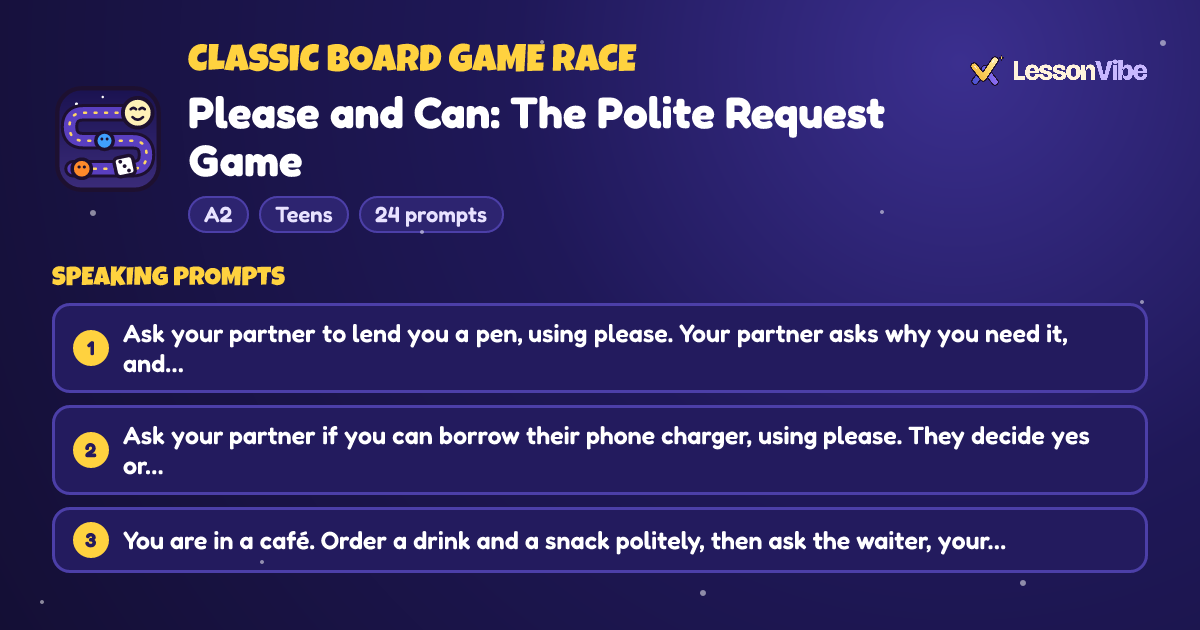
- Ask your partner to lend you a pen, using please. Your partner asks why you need it, and you explain.
- Ask your partner if you can borrow their phone charger, using please. They decide yes or no and give a reason.
- You are in a café. Order a drink and a snack politely, then ask the waiter, your partner, how much it costs.
- Act out asking a shop assistant for a bigger size without words. Your team guesses, then makes the polite request aloud.
- Your team must agree: which is more polite, 'Give me water' or 'Can I have some water, please?' Explain why.
- Ask your partner what they usually ask their parents for at the weekend and how they ask for it.
- You are lost in a new town. Ask a stranger, your partner, for directions to the train station. They give real directions.
- Describe a time you asked a teacher for help. What did you ask for, and what did the teacher say?
- You have 30 seconds to present your best tips for asking for something politely. Use 'please' and 'can' in your talk.
- Stand up and mime asking a friend to open the window. Your team guesses, then makes the request politely with please.
- Discuss with your group: what can you say if someone says no to your request? Agree on the best polite answer.
- Role-play with your partner: your friend borrowed your book and did not return it. Ask for it back politely.
- ⭐ You want to stay up late on Saturday. Convince your partner, playing your parent, using please, can, and one good reason.
- At a restaurant, your soup is cold. Explain the problem to the waiter, your partner, and ask politely for a new one.
- Compare asking a friend and asking a teacher for help. What words do you change? Give one example of each.
- Ask your partner which is easier for them: asking for help in a shop or in class. Find out why.
- Act out asking a librarian for a book about your favourite hobby. Your partner is the librarian and asks you questions.
- Which request is hardest for you: asking for money, asking for help, or asking for a favour? Explain why.
- Explain how you ask for a glass of water at a friend's house. Your partner, as the friend, offers something different.
- Tell your partner about the last thing you asked a family member for. Did they say yes? What happened next?
- ⭐ Your team must plan a class party. Each player politely asks another player to bring one thing and gives a reason.
- ⭐ Have you ever asked a stranger for help? Describe what happened, or imagine what you can say if you need help.
- Your phone battery is dead. Ask a person at the bus stop, your partner, if you can make a short call.
- ⭐ You have 60 seconds to convince your teacher to give the class no homework this weekend. Use please and can.
Printable worksheet
This Classic Board Game Race comes with a free printable worksheet: 2 parts for students to do after the game, and an answer key for the teacher. It prints at three levels (Support, Core and Challenge); this is the Core sheet. Sign in free to print the whole sheet.
What's on the worksheet
- Answer the card · Answer with a full sentence.
- The board game on paper
Part 1: Answer the card
Answer with a full sentence.
- Stand up and mime asking a friend to open the window. Your team guesses, then makes the request politely with please.
- Discuss with your group: what can you say if someone says no to your request? Agree on the best polite answer.
- You are lost in a new town. Ask a stranger, your partner, for directions to the train station. They give real directions.