Opposites Jeopardy Game
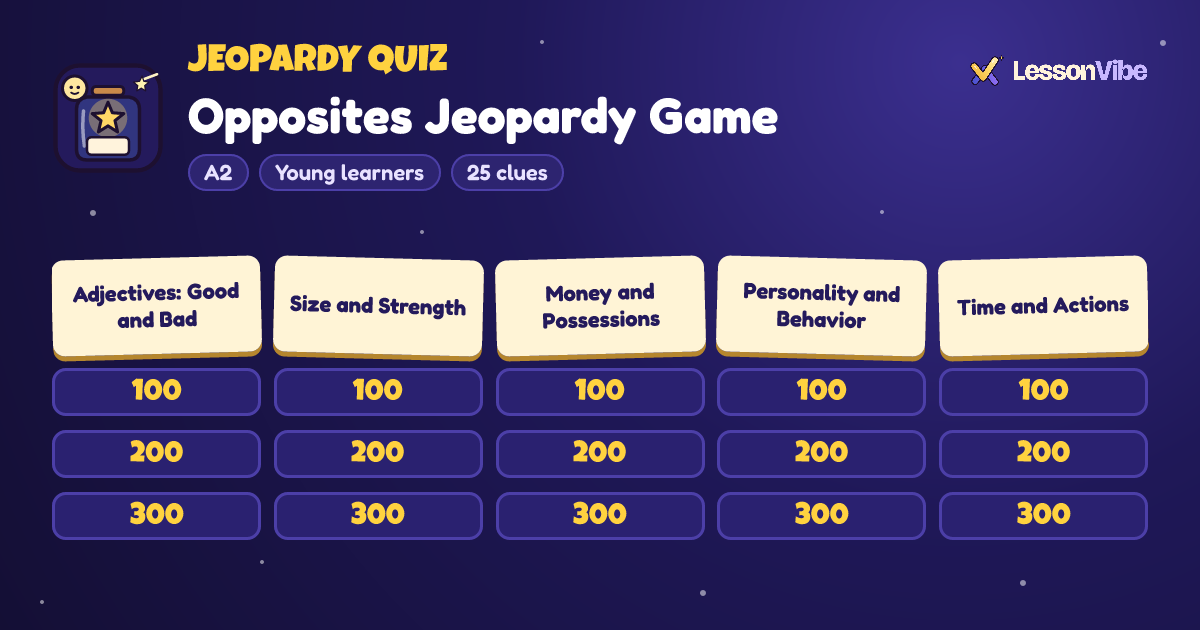
An interactive ESL Jeopardy game for young learners at CEFR A2 level focusing on opposite words and concepts. Players answer questions about antonyms across five engaging categories, with increasing difficulty and communicative output at higher point values.
A free Jeopardy Quiz for Young learners at CEFR A2 level. Topic: opposites.
Categories
- Adjectives: Good and Bad
- Size and Strength
- Money and Possessions
- Personality and Behavior
- Time and Actions
Questions
- Adjectives: Good and Bad (100): What is the opposite of happy?
- Adjectives: Good and Bad (200): If something is not clean, what word describes it?
- Adjectives: Good and Bad (300): Tell me two opposite adjectives. One means you like something very much, and one means you do not like it.
- Adjectives: Good and Bad (400): Describe how a kind person is different from a mean person. Use complete sentences.
- Adjectives: Good and Bad (500): Think of a time when you felt happy and a time when you felt sad. Tell us about one of these times using two or three sentences.
- Size and Strength (100): What is the opposite of big?
- Size and Strength (200): If someone is weak, what is the opposite word?
- Size and Strength (300): Name two opposite words about size. Then use them in a sentence about animals.
- Size and Strength (400): Explain how a strong person and a weak person are different. What can they do differently?
- Size and Strength (500): Compare yourself to someone else. Tell us if you are stronger or weaker, bigger or smaller. Explain why you think this.
- Money and Possessions (100): What is the opposite of rich?
- Money and Possessions (200): If you have a lot of money, are you rich or poor?
- Money and Possessions (300): Give two examples of things that a rich person might have that a poor person might not have.
- Money and Possessions (400): Describe what life might be like for a rich person and a poor person. How is their life different?
- Money and Possessions (500): Tell us about something you have that is important to you. Is it expensive or not expensive? Why do you like it?
- Personality and Behavior (100): What is the opposite of kind?
- Personality and Behavior (200): If someone is serious, what is the opposite word?
- Personality and Behavior (300): Give two examples of kind behavior and two examples of mean behavior.
- Personality and Behavior (400): Compare a serious person with a funny person. What do they do differently? How do they make others feel?
- Personality and Behavior (500): Describe a time when you were kind to someone. What did you do and how did it make them feel? Use past tense.
- Time and Actions (100): What is the opposite of fast?
- Time and Actions (200): If something is easy, what is the opposite word?
- Time and Actions (300): Name one thing that is fast and one thing that is slow. Explain why.
- Time and Actions (400): Tell us about an easy task and a difficult task. Why is one harder than the other?
- Time and Actions (500): Compare how you do something fast with how you do the same thing slowly. What is different? When would you do each?