More Than One Way to Earn a Living - ESL Jeopardy
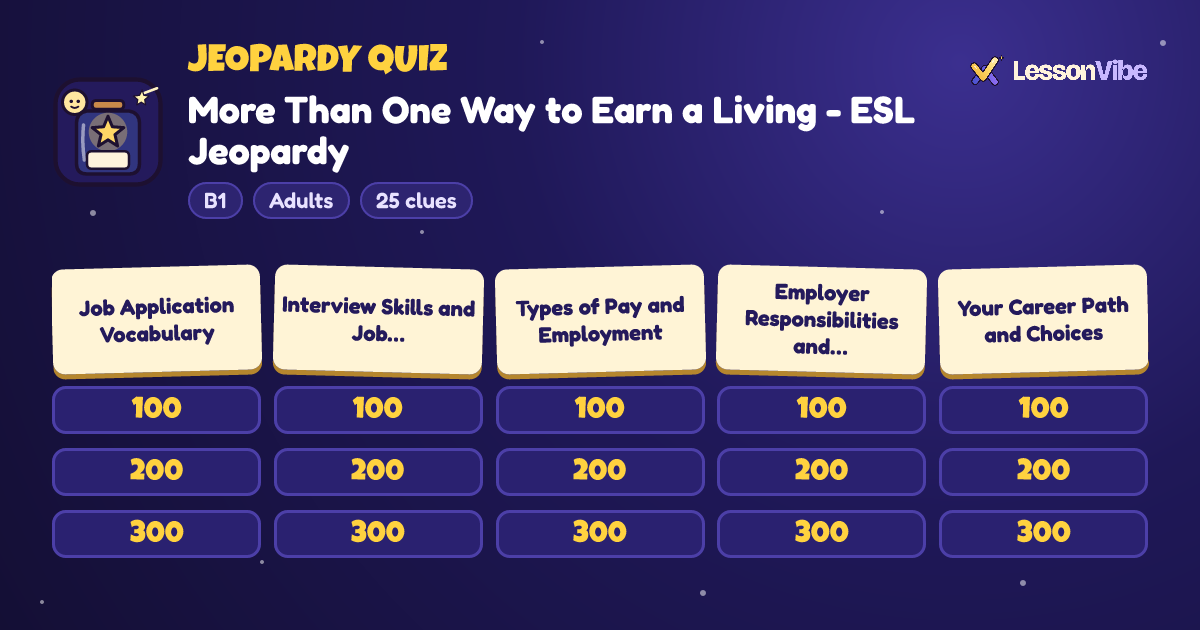
An interactive Jeopardy game for adult learners at B1 level focusing on job applications, employment vocabulary, and career discussions. Players answer questions about job requirements, application processes, interview skills, and different ways to earn money.
A free Jeopardy Quiz for Adults at CEFR B1 level. Topic: More than one way to earn a living.
Categories
- Job Application Vocabulary
- Interview Skills and Job Requirements
- Types of Pay and Employment
- Employer Responsibilities and Hiring
- Your Career Path and Choices
Questions
- Job Application Vocabulary (100): What is the document that shows your work experience and education called?
- Job Application Vocabulary (200): Explain what it means to 'complete an application form' when you apply for a job.
- Job Application Vocabulary (300): Why is it important to send an up-to-date CV to an employer?
- Job Application Vocabulary (400): What is a 'reference' and why might an employer ask you for one?
- Job Application Vocabulary (500): Compare getting a reference from a current employer versus a former employer. What are the advantages and disadvantages of each?
- Interview Skills and Job Requirements (100): What should you do before an interview to prepare?
- Interview Skills and Job Requirements (200): Describe what 'having the necessary qualifications' for a job means.
- Interview Skills and Job Requirements (300): What does it mean to 'stand out against other candidates' in a job interview?
- Interview Skills and Job Requirements (400): Why is it a bad idea to ask random questions at an interview instead of listening carefully to the interviewer?
- Interview Skills and Job Requirements (500): If you do not have all the necessary qualifications for a job, how could you still try to stand out and convince an employer to hire you?
- Types of Pay and Employment (100): What is an 'hourly rate' in a job?
- Types of Pay and Employment (200): Explain the difference between receiving 'wages' and receiving a 'monthly salary'.
- Types of Pay and Employment (300): What are some jobs where workers receive an hourly rate instead of a monthly salary?
- Types of Pay and Employment (400): Explain why some employers prefer to hire employees on an hourly rate rather than give them a monthly salary.
- Types of Pay and Employment (500): Compare the advantages and disadvantages of working for an hourly rate versus having a monthly salary. Which would you prefer and why?
- Employer Responsibilities and Hiring (100): What does it mean when an employer decides to 'hire someone'?
- Employer Responsibilities and Hiring (200): Describe what an employer does when they 'review the job description' before hiring someone.
- Employer Responsibilities and Hiring (300): Why should an employer review the job description before hiring someone?
- Employer Responsibilities and Hiring (400): What steps should an employer take to hire someone who will be a good fit for the company?
- Employer Responsibilities and Hiring (500): If you were an employer, how would you use references, the job description, and interviews together to make sure you hire the best person for the job?
- Your Career Path and Choices (100): What type of job would you like to apply for in the future?
- Your Career Path and Choices (200): What qualifications or skills do you already have that would help you get a job you want?
- Your Career Path and Choices (300): Describe what qualifications or skills you still need to develop to get your dream job.
- Your Career Path and Choices (400): How is earning money through an hourly rate different from your current or desired work situation? Explain your answer.
- Your Career Path and Choices (500): If you were applying for a job you really wanted, what would you do to stand out against other candidates and convince the employer to hire you?