Heavy Equipment Operations Jeopardy
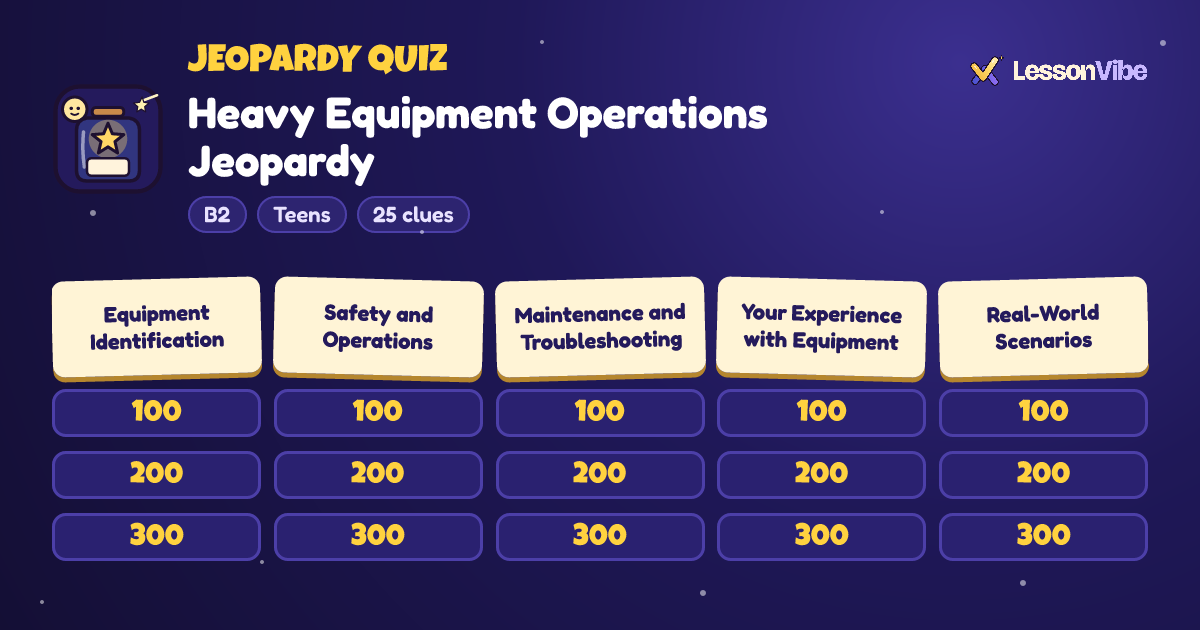
An interactive Jeopardy-style game for B2-level teen ESL learners focused on heavy equipment operations. Features five categories with questions ranging from basic terminology to complex scenario analysis. Encourages group discussion and spoken English production.
A free Jeopardy Quiz for Teens at CEFR B2 level. Topic: Heavy equipment Operations.
Categories
- Equipment Identification
- Safety and Operations
- Maintenance and Troubleshooting
- Your Experience with Equipment
- Real-World Scenarios
Questions
- Equipment Identification (100): This machine has a large bucket attached to an arm and is commonly used for digging and moving soil at construction sites.
- Equipment Identification (200): What is the main difference between a bulldozer and a wheel loader in terms of their primary functions?
- Equipment Identification (300): Describe the key features that make a motor grader different from other heavy equipment used on construction sites.
- Equipment Identification (400): Compare the advantages of using a crawler excavator versus a wheeled excavator on different types of terrain and job sites.
- Equipment Identification (500): Explain why a compactor is essential in road construction projects and describe what would happen if this equipment were not used properly.
- Safety and Operations (100): Name three pieces of personal protective equipment that operators must wear when working with heavy equipment.
- Safety and Operations (200): Why is it important to conduct a pre-operation inspection before starting heavy equipment each day?
- Safety and Operations (300): What are the main hazards that operators face when working near other workers or vehicles on a busy construction site?
- Safety and Operations (400): Discuss what safety procedures an operator should follow if they notice hydraulic fluid leaking from their excavator during a job.
- Safety and Operations (500): Analyze how poor communication between equipment operators and ground workers can lead to serious accidents, and suggest ways to prevent these incidents.
- Maintenance and Troubleshooting (100): What is the purpose of changing the oil regularly in heavy equipment engines?
- Maintenance and Troubleshooting (200): How would you identify if the hydraulic system in a bulldozer is not working properly?
- Maintenance and Troubleshooting (300): Explain what routine maintenance tasks should be performed on heavy equipment to extend its lifespan and reduce repair costs.
- Maintenance and Troubleshooting (400): Describe the steps an operator should take when their equipment makes an unusual grinding noise during operation.
- Maintenance and Troubleshooting (500): Compare the maintenance requirements of tracked equipment versus wheeled equipment, and explain which type typically requires more frequent maintenance.
- Your Experience with Equipment (100): Have you ever watched heavy equipment being used at a construction site? Describe what you saw and what the equipment was doing.
- Your Experience with Equipment (200): If you were training to become a heavy equipment operator, which type of equipment would you most like to learn to operate and why?
- Your Experience with Equipment (300): Compare the skills required to operate a small piece of equipment like a mini excavator with the skills needed for a large bulldozer.
- Your Experience with Equipment (400): How is working as a heavy equipment operator different from the job of a construction worker on the ground, and which would you find more challenging?
- Your Experience with Equipment (500): Imagine you are an equipment operator who discovers a serious safety problem on your job site. Explain how you would handle this situation and what you would do.
- Real-World Scenarios (100): A construction company needs to clear a large area of trees and rocks to prepare the ground for a new building. Which equipment would be most useful for this job?
- Real-World Scenarios (200): Why might a construction manager choose to rent equipment instead of buying it for a short-term project?
- Real-World Scenarios (300): Describe what steps a construction team would take to safely move a large excavator from one job site to another location several kilometers away.
- Real-World Scenarios (400): Explain how weather conditions such as heavy rain or extreme heat could affect equipment operations and what precautions operators should take.
- Real-World Scenarios (500): A construction project is behind schedule and the manager wants operators to work faster. Discuss how this pressure could compromise safety and what operators should do.