Ethos, Pathos, Logos: The Persuasion Challenge
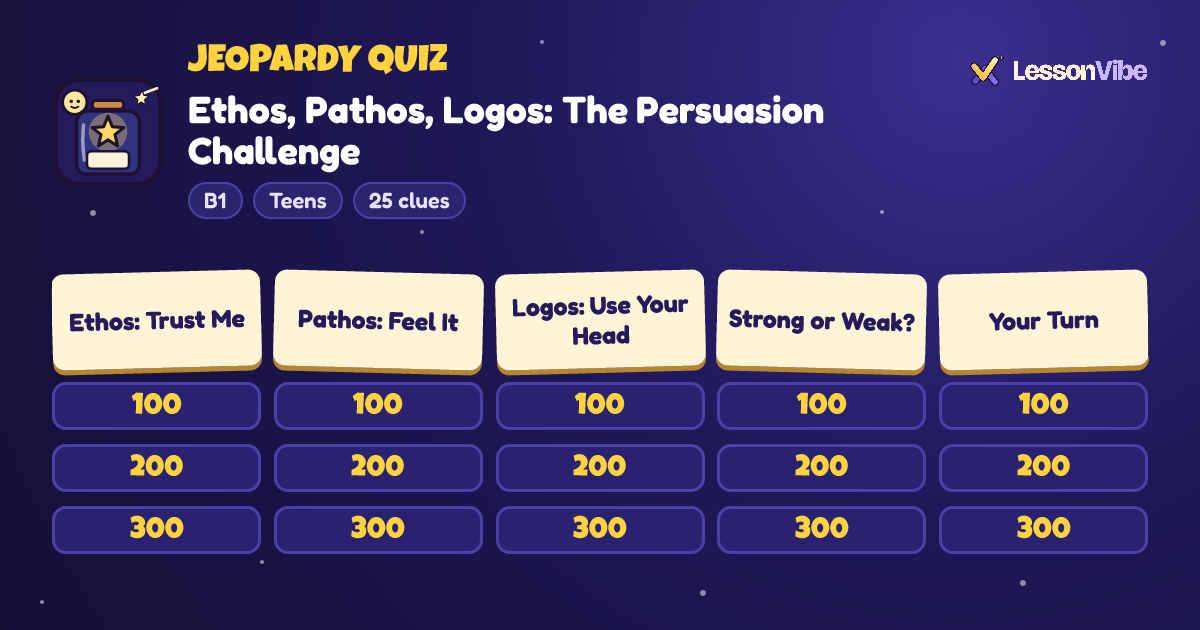
A Jeopardy-style review game for students aged 11 to 14. Three teams show what they have learned about rhetoric and argument. They explain ethos, pathos and logos, spot weak arguments, and build their own persuasive ideas.
A free Jeopardy Quiz for Teens at CEFR B1 level. Topic: rhetoric and argument.
Categories
- Ethos: Trust Me
- Pathos: Feel It
- Logos: Use Your Head
- Strong or Weak?
- Your Turn
Questions
- Ethos: Trust Me (100): Ethos is one of the three ways to persuade people. What does a speaker use when they use ethos?
- Ethos: Trust Me (200): A toothpaste advert shows a dentist who says, "I use this toothpaste every day." Explain why this is an example of ethos.
- Ethos: Trust Me (300): Name two things a speaker can say or do to make an audience trust them more.
- Ethos: Trust Me (400): A famous footballer says in an advert that a new phone is the best phone in the world. Explain why this ethos might not be very strong.
- Ethos: Trust Me (500): You want to persuade your head teacher to make the lunch break longer. Describe how you would use ethos in your speech and say why it would work.
- Pathos: Feel It (100): Pathos persuades people through their feelings. Name two feelings that an advert or speech might try to make you feel.
- Pathos: Feel It (200): A charity advert shows a hungry, sad dog sitting alone in the rain. What does the advert want you to feel, and what does it want you to do?
- Pathos: Feel It (300): Compare these two sentences: "The town has a problem with rubbish" and "Our beautiful town is drowning in rubbish." Why is the second one more emotional?
- Pathos: Feel It (400): Explain why pathos can be dangerous when a speaker uses only feelings and gives no facts.
- Pathos: Feel It (500): A speech about saving the ocean could tell the story of one sea turtle, or it could show a shocking photo of a beach full of plastic. Compare these two ways of using pathos. Which would work better…
- Logos: Use Your Head (100): Logos is the third way to persuade. What kind of things does a speaker use when they use logos?
- Logos: Use Your Head (200): Look at two sentences: "This game is totally awesome!" and "This game has 50 levels and costs less than most other games." Which one uses logos, and how do you know?
- Logos: Use Your Head (300): Good logos arguments often use the word "because". Finish this argument with a logical reason: "Our school should have more water fountains because..."
- Logos: Use Your Head (400): Explain why a fact from a trusted science website is usually stronger evidence than a fact from a random comment online.
- Logos: Use Your Head (500): Describe the steps of building a logical argument, from the main idea to the ending. Use a short example to show each step.
- Strong or Weak? (100): Someone says, "Everybody has this phone, so you should buy it too." Why is this a weak reason to buy something?
- Strong or Weak? (200): A student says, "Don't listen to Sam's idea for the school trip. He is always late for class." What is wrong with this argument?
- Strong or Weak? (300): Someone says, "Either we ban phones in school completely, or students will never learn anything." Explain why this argument is too simple.
- Strong or Weak? (400): An advert for sweets says, "Doctors love our sweets!" but gives no names, numbers or other details. Which appeal is the advert trying to use, and why is it weak?
- Strong or Weak? (500): Here is a weak argument: "Homework is bad. Everyone hates it." Rewrite it to make it stronger using logos, and explain what you changed.
- Your Turn (100): When you watch adverts, which appeal persuades you most: ethos, pathos or logos? Give one reason.
- Your Turn (200): Think of a time you persuaded a parent or friend to do something. What did you say, and which appeal did you use?
- Your Turn (300): If you made a poster to stop people dropping litter at your school, what picture and words would you use? Say which appeals they show.
- Your Turn (400): Compare how you would persuade your best friend with how you would persuade a teacher. What would change, and why?
- Your Turn (500): Give a short, 30-second argument about whether school should start later for teenagers. Use ethos, pathos and logos at least once each.