Bucket List Jeopardy: Dreams, Plans and Adventures
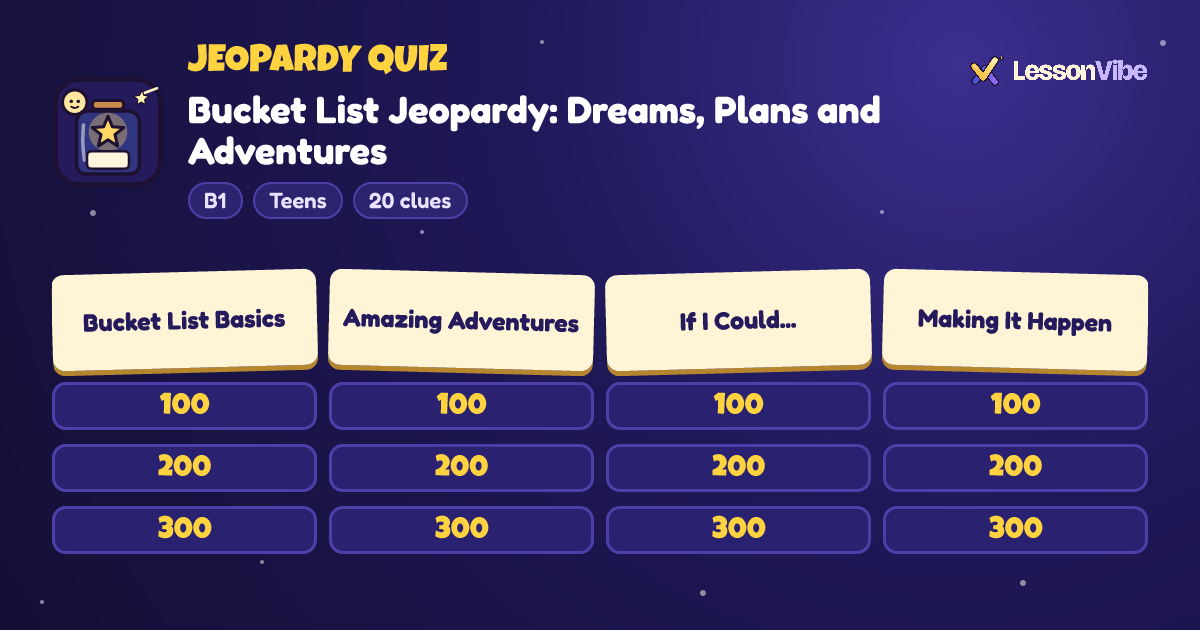
A speaking-focused Jeopardy game for B1 teens. Teams review bucket list vocabulary, talk about famous adventures, share personal dreams with 'If I could...', and explain how to plan their goals. Higher-point questions ask students to give reasons, compare ideas, and describe steps.
A free Jeopardy Quiz for Teens at CEFR B1 level. Topic: BUCKET LİST.
Categories
- Bucket List Basics
- Amazing Adventures
- If I Could...
- Making It Happen
Questions
- Bucket List Basics (100): A bucket list is a special kind of list. People write down things they really want to do. When do people want to do all these things?
- Bucket List Basics (200): People often start talking about their bucket list with the words 'I've always wanted to...'. Finish this sentence with a real dream of your own and say it to the class.
- Bucket List Basics (300): A dream is something you hope for. A goal is something you plan and work for. Explain the difference between a dream and a goal, and give one example of each.
- Bucket List Basics (400): Some bucket list items are big, like climbing a mountain. Others are small, like learning to cook a family dish. Why are small items also important on a bucket list? Give at least one reason.
- Bucket List Basics (500): Some people think bucket lists are only for older people. Others believe teenagers should have one too. What do you think? Give two reasons for your opinion.
- Amazing Adventures (100): Many people dream of seeing the Northern Lights. These are colourful lights that appear in the night sky in very cold places. Name one country where people often go to see them.
- Amazing Adventures (200): Skydiving is a popular bucket list activity. People jump out of a plane and fall through the air. What do they use to land safely, and how would you feel before jumping?
- Amazing Adventures (300): Mount Everest is the highest mountain in the world. Climbing it is on many bucket lists, but it is very dangerous. Name two things that make climbing it so difficult.
- Amazing Adventures (400): Imagine you can choose between swimming with dolphins and flying in a hot-air balloon. Compare the two activities. Which one would you choose, and why?
- Amazing Adventures (500): Some bucket list trips, like visiting the Great Wall of China, can cost a lot of money. A teenager cannot usually pay for it right away. Describe at least three steps a teenager could take to make…
- If I Could... (100): Complete this sentence about yourself: 'If I could visit any city in the world, I would go to ___.' Then say one thing you would do there.
- If I Could... (200): Imagine you have one free day with no school and no rules. What would you do from morning to night? Use 'I would...' in your answer.
- If I Could... (300): If you could learn any new skill this year, what would it be? Explain why you want to learn it and how it could help you in the future.
- If I Could... (400): Think about a dream that someone in your family has, like a parent or grandparent. How is their dream different from your own dream? Compare the two dreams.
- If I Could... (500): Imagine you finish everything on your bucket list by the time you are 30. How would your life be different from now? Describe how you would feel and what you would do next.
- Making It Happen (100): We use 'going to' to talk about future plans. Which sentence is correct? A) I going to travel next year. B) I am going to travel next year.
- Making It Happen (200): Running a marathon is a big bucket list goal. Nobody can do it without getting ready first. Name two things a person should do to prepare for a marathon.
- Making It Happen (300): Talk about your own bucket list using the present perfect. Make one sentence with 'I have already...' and one sentence with 'I haven't... yet'.
- Making It Happen (400): Many people write a bucket list but never do anything on it. Why do you think this happens? Give two reasons and one idea to fix the problem.
- Making It Happen (500): Choose one big dream from your bucket list. Explain how you would turn it into a real plan, step by step. Describe what you would do first, what you would do next, and how you would know you have…