Automotive Breakdowns: English for the Workplace
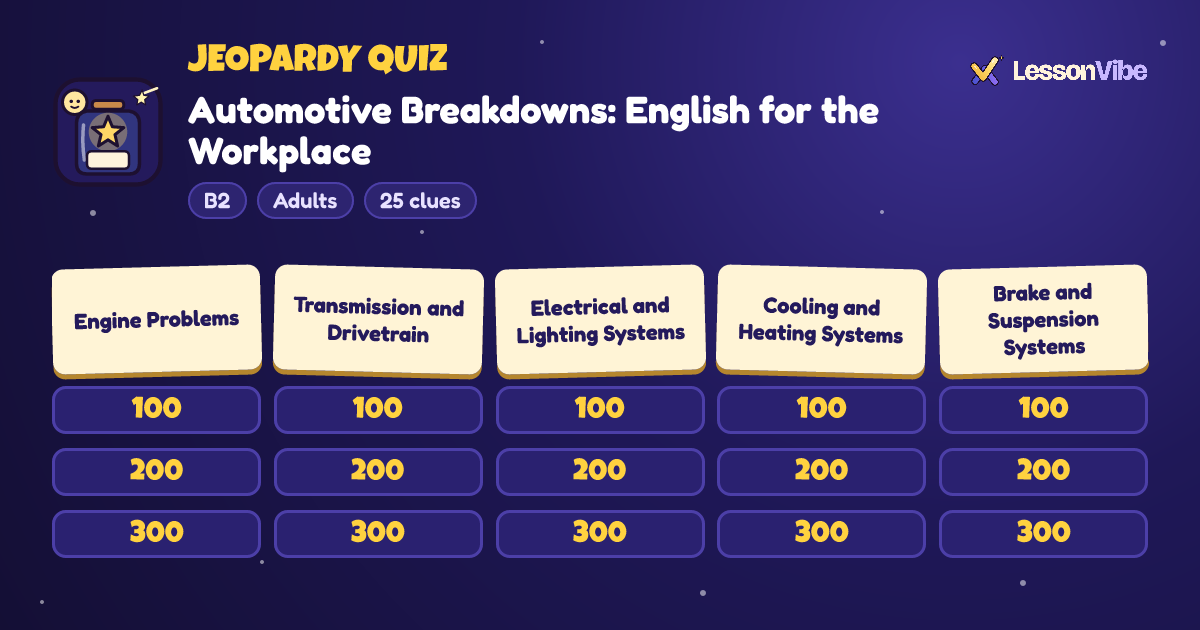
An interactive Jeopardy-style game focusing on common car breakdowns, diagnostic terminology, and professional communication in automotive contexts. Designed for adult ESL learners at B2 level working in or studying the automotive industry.
A free Jeopardy Quiz for Adults at CEFR B2 level. Topic: Common car breakdowns.
Categories
- Engine Problems
- Transmission and Drivetrain
- Electrical and Lighting Systems
- Cooling and Heating Systems
- Brake and Suspension Systems
Questions
- Engine Problems (100): What is the most common symptom when a car's battery is dead or dying?
- Engine Problems (200): Explain what happens when an engine overheats and how you would describe this situation to a mechanic.
- Engine Problems (300): What is a misfire, and what warning signs might a driver notice on the dashboard?
- Engine Problems (400): Describe the difference between a blown head gasket and a cracked engine block, and why both are serious problems.
- Engine Problems (500): Explain what carbon buildup in an engine means and how it affects vehicle performance over time.
- Transmission and Drivetrain (100): What does it mean when a customer says their car is slipping out of gear while driving?
- Transmission and Drivetrain (200): How would you explain transmission fluid leaks to a non-technical customer, and why is this a concern?
- Transmission and Drivetrain (300): What is the difference between automatic and manual transmission problems, and how would symptoms differ?
- Transmission and Drivetrain (400): Explain what torque converter issues are and how they specifically affect automatic transmission vehicles.
- Transmission and Drivetrain (500): Discuss how differential problems manifest in a vehicle and why they are critical for safe driving in turns.
- Electrical and Lighting Systems (100): What should you tell a customer if their headlights are not working properly?
- Electrical and Lighting Systems (200): Explain what an alternator does and why a failing alternator prevents a car from running.
- Electrical and Lighting Systems (300): What are the common signs of a faulty starter motor, and how would you describe them to a customer?
- Electrical and Lighting Systems (400): Explain the relationship between a parasitic drain and battery discharge, and how technicians diagnose this issue.
- Electrical and Lighting Systems (500): Discuss how a corroded battery terminal affects vehicle performance and what preventive maintenance measures should be recommended.
- Cooling and Heating Systems (100): What does it mean when a customer reports that their car's heater is blowing cold air?
- Cooling and Heating Systems (200): Explain the purpose of coolant in a vehicle and what happens if coolant levels are too low.
- Cooling and Heating Systems (300): What is a thermostat, and how do you recognize symptoms of a thermostat failure?
- Cooling and Heating Systems (400): Describe what a radiator leak is, how it develops, and the risks if it is not repaired promptly.
- Cooling and Heating Systems (500): Explain the function of a water pump in the cooling system and what consequences occur when it fails.
- Brake and Suspension Systems (100): What should you advise a customer if they notice their brake pedal feels soft or spongy?
- Brake and Suspension Systems (200): Explain what brake pads are and why they need to be replaced regularly.
- Brake and Suspension Systems (300): What are common warning signs of suspension problems, and how do they affect vehicle handling?
- Brake and Suspension Systems (400): Describe the difference between brake fade and brake failure, and explain why brake fade is a safety concern.
- Brake and Suspension Systems (500): Explain how a faulty ABS system affects braking performance and what warning indicators a driver might observe.